My Marxist Valentine - notes on the poems
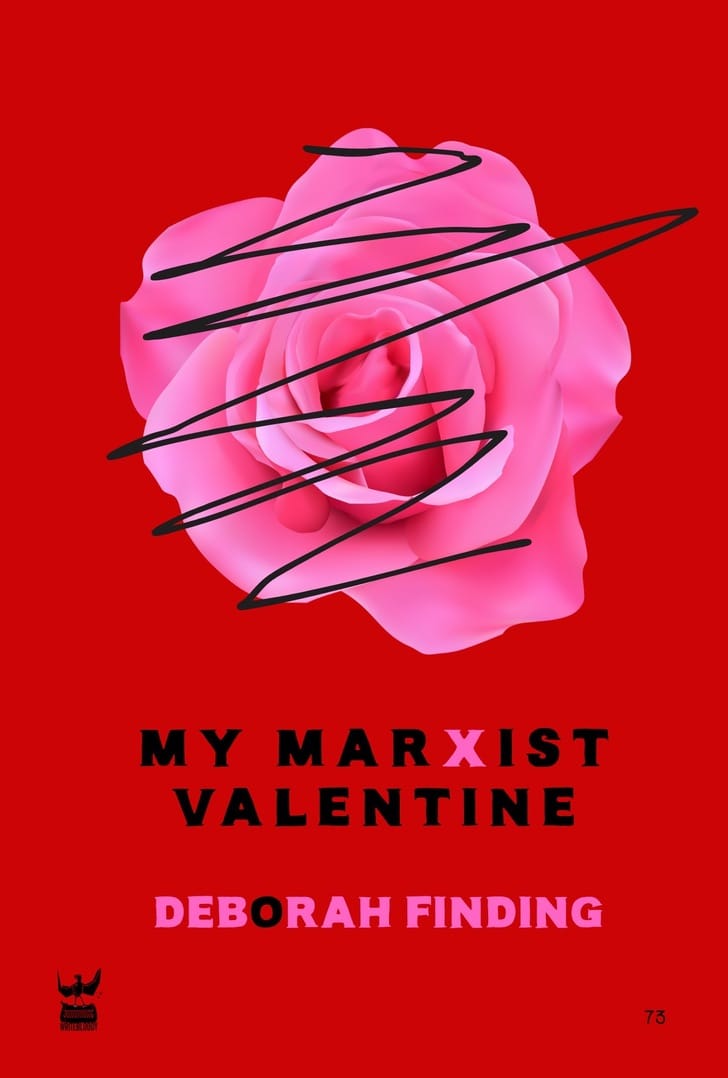
These notes also appear at the back of the book. Links to the books referenced in these notes can be found here.
ACCESSIBLE (POETS OF THE WORLD, UNITE!) was shortlisted for the Write By The Sea Poetry Competition, 2024. It was originally commissioned by the Soho Poly in London, which was one of the first theatres to prioritise female, LGBTQ+ and racially minoritised playwrights and actors. ‘Poets of the world, unite!’ is a play on the last line of The Communist Manifesto by Karl Marx and Fredrich Engels.
VENN DIAGRAM CAST LIST is a tongue-in-cheek introduction to the three revolutionary women referenced throughout this book: Eleanor Marx (1855-1898), Emma Goldman (1869-1940) and Rosa Luxemburg (1871-1919), and the fact that their partners (Edward Aveling for Eleanor Marx, Alexander / Sasha Berkman and Ben Reitman for Emma Goldman, and Leo Jogiches for Rosa Luxemburg) did not treat them in ways compatible with their professed communist and proto-feminist beliefs.
MEET CUTE is titled for the Hollywood trope in romance films where the two main characters meet in an unusual or charming way. The direct speech and locations in the poem are taken from the description of anarchists Emma Goldman and Alexander / Sasha Berkman’s first meeting, described in Paul and Karen Erlich’s biography, Emma and Sasha. The ‘shot that changed everything’ is a reference to Berkman’s failed attempt to assassinate Henry Clay Frick during the Homestead Strike. He was imprisoned, and despite Goldman’s dedication to him through those years - their letters, visits, and her best attempts afterwards, he could not recapture his desire for her when he was released – instead becoming involved with a young member of the movement, the 15-year-old Becky Edelman. However, Emma and Sasha remained friends and comrades for life, something Emma anticipated when they first met, saying, ‘Deep love for him welled up in my heart, a feeling of certainty that our lives were linked for all time.’
VIII: JUSTICE is named for the eighth Major Arcana tarot card, whose imagery is also used in the poem.
OUR GOLDEN RECORD is a reference to the ‘golden record’ created for NASA’s Voyager Interstellar Mission, by physicist Carl Sagan and the creative director of the project, Ann Druyan. The golden records, which were meant to survive for a billion years onboard, contained greetings in 59 languages, music from all over the world, and other significant human sounds, like a mother’s first words to her newborn, or a kiss. The hope was that, despite the odds, they might cross paths with an alien civilisation and be able to communicate the meaning of life on Earth. When Druyan found a perfect piece of music they had both been searching for, she left a message for Sagan. He called back, and by the end of that phone call, the two – who had been just friends and collaborators up to that point – had become engaged. Druyan then had the idea that they could record the electrical impulses of a human brain and nervous system and turn it into sound, which an alien life form might be able to re-translate to thought. The person they recorded was Druyan, while she was thinking about love, and in particular, falling in love with Sagan. Their golden record is still out there somewhere.
ALLIES IN THE WORKPLACE was shortlisted for the Hexham Poetry Prize, 2023.
The two Greek poetry quotes in AMPLIFY are from Tasos Leivaditis’ poems, ‘But in the evening’ and ‘Erotic’, respectively. Vergangenheitsbewältigung is a German word which refers to engaging with, or working through, the past sins of your people or country. ‘Keats is dead…’ is a reference to the Hera Lindsay Bird poem, ‘Keats is dead so fuck me from behind’.
The epigraph to MY GLASS UNICORN HEART, “how beautiful it is and how easily it can be broken”, is from Tennessee Williams’ description of the glass unicorn in The Glass Menagerie.
The title READER, I is a reference to the famous line in the final chapter of Charlotte Brontë’s Jane Eyre, ‘Reader, I married him.’ The final part of the poem refers to the line ‘the love that dare not speak its name’ from the Lord Alfred ‘Bosie’ Douglas poem, ‘Two Loves’, which was famously used as evidence against his lover Oscar Wilde in his 1895 conviction for gross indecency on the grounds of homosexual acts.
APPETITE was longlisted for the Fish Poetry Prize, 2022.
FOR MY MARXIST VALENTINE was first published in Magma (Issue 92: ‘Ownership’), 2025
The direct quotes in EMMA GOLDMAN NEVER SAID, ‘IF I CAN’T DANCE, IT’S NOT MY REVOLUTION’ are taken from Paul and Karen Erlich’s biography of Emma Goldman and Alexander Berkman, Emma and Sasha. The generosity towards Sasha is a reflection of Emma’s own, describing him as, ‘Critical, of course, but always in the finest and broadest spirit’ (Goldman, Living My Life).
The title A DREAM IS A WISH YOUR HEART MAKES is taken from a song in the Disney film Cinderella.
MAZAN is the name of the town where Gisèle Pelicot was covertly drugged and raped over a nine-year period by her husband and the other men he had invited to participate. At the trial, she described how she had previously considered him to be ‘the perfect husband’.
THE BRIDE OF ARTA is based on the Greek folk ballad, The Bridge of Arta. In the original, the Master Builder and his team build a bridge across Arta’s river, but it collapses each night, until one day, a bird with a human voice brings the news that, in order for it to stand, the Master Builder must sacrifice his wife and build her into the foundations. He does. The song has a happy ending. ‘The Bride of Arta’ is her story. This poem was shortlisted for the Renard Press prize and published in the resulting anthology, Building Bridges (2024).
The details in ELEANOR’S LAST DAY BEING are taken from Rachel Holmes’ biography, Eleanor Marx.
The term eigengrau referred to in 1 IN 4 WOMEN CAN’T UNHAUNT THEMSELVES was coined by physicist and philosopher Gustav Fechner (1801-1887) who devoted his career to exploring sensation and perception.
HOW YOU HATE IT WHEN I CALL YOU MR DARCY is a pastiche of Elizabeth Bennet and Mr Darcy’s conversation in Jane Austen’s Pride and Prejudice about what constitutes an accomplished woman.
The final line of THE MATTER AT HAND references Sylvia Plath’s much-quoted line from The Bell Jar, ‘I took a deep breath and listened to the old brag of my heart. I am. I am. I am.’
BREAD AND ROSES was shortlisted for the 2023 Live Canon International Poetry Prize and published in the 2023 Anthology. The epigraph is taken from the poem ‘Bread and Roses’ by James Oppenheim, which was turned into the famous women’s labour movement song of the same name. The title - which also became associated with the Massachusetts textile strike of 1912 - and the sentiment were based on a 1910 speech by women’s suffrage activist Helen Todd.
ISN’T IT BEAUTIFUL? was one of the runners-up in the Oxford Poetry Library ‘Taste’ Competition, 2024. The words in italics are the English pronunciations of the Greek words for the associated descriptions. There are no equivalent single English words.
WHEN THE HEART IS FULL, THE MOUTH MUST SPEAK is a cento, meaning it is taken entirely (including the title here) from lines from another work – in this case, Rosa Luxemburg’s letters to Leo Jogiches, collected in Comrade and Lover (ed. Elizbieta Ettinger).
CONCRETE CONFESSION was first published in The Alchemy Spoon (Issue 9, ‘Graffiti’), 2023.
The title IS ONE OF US SUPPOSED TO BE A DOG IN THIS SCENARIO? is a line in the famous argument scene in the 1989 romantic comedy When Harry Met Sally.
The answers to WHO SAID IT – KARL MARX OR JANE AUSTEN? are as follows: 1/ Austen, Northanger Abbey, 2 / Marx (Letter to Engels), 3/ Austen, Northanger Abbey, 4/ Austen, Mansfield Park, 5 / Austen, Emma, 6/ Marx (Love letter to Jenny), 7/ Austen, Emma, 8/ Marx (Love letter to wife Jenny), 9/ Austen, Persuasion, 10/ Austen, Pride and Prejudice
WHEN I ARGUE, I FORGET TO BE (ME)EK was longlisted for the Live Canon International Poetry Prize and first published the resulting 2024 Anthology. It has also been published in You’re Never Too Much: Poems For Every Emotion (2025), a Pan Macmillan Young Adult poetry anthology.
IF EMMA GOLDMAN HAD TAKEN ROSA LUXEMBURG AND ELEANOR MARX FOR MARGARITAS is a wish fulfilment exercise seeking to mitigate or prevent the suffering experienced by these three exceptional women (including the significant amount inflicted by the men in their lives), and as such it takes liberties with time and the order of those events. The lyrics in the song snippet played to Rosa at the beginning of the poem are from ‘I Do This All The Time’ by Self Esteem. Rosa Luxemburg’s lover Leo Jogiches used her political and writing talent to elevate his own status. He kept telling her he would marry her but insisted on their relationship not being public. When she finally left him, he stalked her for two years, including using a key to enter the flat they had shared, and physically threatened her. Rosa was murdered in 1919, aged 47, in Berlin by an elite paramilitary unit instructed by the state to suppress the communists. Eleanor Marx was abused financially and sexually by Edward Aveling, who married a younger woman in secret, while still living with Eleanor. He kept the death of his first wife a secret, while telling Eleanor this is the reason they could not marry. He used Eleanor’s fathers name, and her connections for his own benefit. There is some evidence to suggest he may also have sexually abused young girls and that Eleanor may have discovered this before killing herself in 1898, aged 43. Emma Goldman had several relationships, but the two of most significance were Alexander / Sasha Berkman and Ben Reitman (who was widely disliked, like Aveling and Jogiches were). Both were imprisoned, both left her for younger women (in Reitman’s case, having impregnated his lover). However, Emma survived her political and personal turmoil, and kept fighting, writing, speaking and living. She began a speech she gave in 1933 called ‘An Anarchist Looks at Life’ by saying, ‘I have been so furiously busy living my life that I had not a moment left to look at it.’ Emma died in 1940 in Toronto, aged 70, and was buried in Chicago, next to the Haymarket martyrs.
REJECTING A POISONED INHERITANCE draws on the fact that Eleanor Marx was the first writer to translate Madame Bovary into English, and her suicide by poison was an almost exact copy of that of Flaubert’s eponymous heroine Emma Bovary.
AND THIS IS THE CRYPT WHERE WE BURIED THE CONCEPT OF ‘THE ONE’ was first published in Magma (Issue 92: ‘Ownership’), 2025
NTOUNIAS is named for the slow food restaurant in Drakona, Crete, in which the poem is set. It won 3rd prize in the Goldsmith Festival Poetry Competition, 2024
LOVING YOU is after the Nazim Hikmet poem of the same name. As well as the title, it borrows the structure, some related imagery, and the final line of the original.
RESURRECTION is written after Paul Verlaine’s poem, ‘The piano, kissed’. Dmitri Shostakovich was a Soviet composer, whose Symphony No. 11 (also known as The Year 1905) was written to commemorate 50 years since the Russian Revolution. Red Moscow was the first Soviet-created perfume. The Russian word Красная (Krasnaya) can be translated as either ‘red’ or ‘beautiful’. The main note in the scent is carnation, the flower of revolution.
REVIVAL (ONE HUNDRED WORDS OF SOLITUDE) is a poem with 100 words, whose title is a play on One Hundred Years of Solitude by Gabriel García Márquez, suggesting a disconnect between romantic thinking’s magical realism and (more prosaic) facts.
WHAT THE COMMUNIST POETS TAUGHT ME references lines from poems by Greek poets Tasos Leivaditis and Yiannis Ritsos, and Turkish poet Nazim Hikmet.
The poet referenced in BUT I DON’T WANT TO WRITE PAST THE ENDING is Caroline Bird. She described this process in an interview with the Forward Arts Foundation as “overshooting the finale to find the ‘unexpected clearing’, the dark untamed place where the poem stops obeying the poet and instead starts speaking back.”